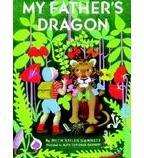
 I’ve spent the past couple of nights reading The Tales of My Father’s Dragon. It got me kind of teary-eyed (though it’s not a teary story) because I’m pretty sure it’s the first book my son handed to me and insisted that I read.
Normally it is me thrusting books into his hands, or reading them out loud with our knees making mountains of the covers. I gave him the Encyclopedia Brown books from my childhood and my battered copy of Patrick Will Grow. My husband and I fought over who would read The Phantom Tollbooth (he won, unfortunately, and they proceeded to read it three times, but I won for Half Magic, the Moomin books, Mrs. Frisby and the Rats of NIMH, and Charlie and the Chocolate Factory.) When my son was sick with Strep throat I held up a copy of Harry Potter and the Sorcerer’s Stone. “Whoa,” he said.
He’s a voracious reader, and he often grabs books that are geared toward older kids. I haven’t stopped him because, as a librarian friend told me, if things get too hard or too scary, kids tend to stop themselves. I often make him promise in the case of books like Phantom Toll Booth, where more layers of meaning come clearer with age, that he’ll read the books again when he’s older. (With Harry Potter, that was the easiest promise he’s ever made; he read it again when he was a few months older than the first time, and again when he was a few months older than that.)
My son’s done a lot of reading on his own where he hasn’t passed the book my way. He didn’t ask me to read any of the Boba Fett series, for instance, so I knew right away that My Father’s Dragon was different. He read the first book in the series during language arts, and then asked if we could go to the library to get the other two. The first book was a Newbery Honor book when it was released back in 1948, so it’s made for an interesting read it this week, when the Newbery medals are being doled out. Believe me, it’s nothing like When You Reach Me or any of the books that have won medals for the past few decades. It’s an old-fashioned book with an old-fashioned feel. And it’s short — in the version I’m reading, the first book of the series is 81 pages, including maps, illustrations, large-ish type and the title page.
My one criticism would be the frequent use of “my father” for the main character, Elmer Elevator. You want to see Elmer as a kid (he is one, after all). But the constant use of “my father” makes him sound older and harder to relate to. I pointed this out to my son, who hadn’t been bothered, but we talked a little about why Harry Potter is more appealing as an 11-year-old boy than if he were in his 40s and trying to control his cholesterol. In the other dragon books, Ruth Stiles Gannett shifts to using the name “Elmer,” so perhaps she agreed.
But I’m not looking to review this book or to find any fault in it: I’m determined to see in it what my son does, which is the silliness of the gum-chewing tigers in an adventure that never feels unsafe. My son’s favorite part is when the alligators float down the river, each with a different animal on his back, and when the mouse wumbles up his jords — I mean jumbles up his words! Even thinking about it cracks him up, which is one of the joys, I think, of age-appropriate reading.
6 Responses to My Father’s Dragon